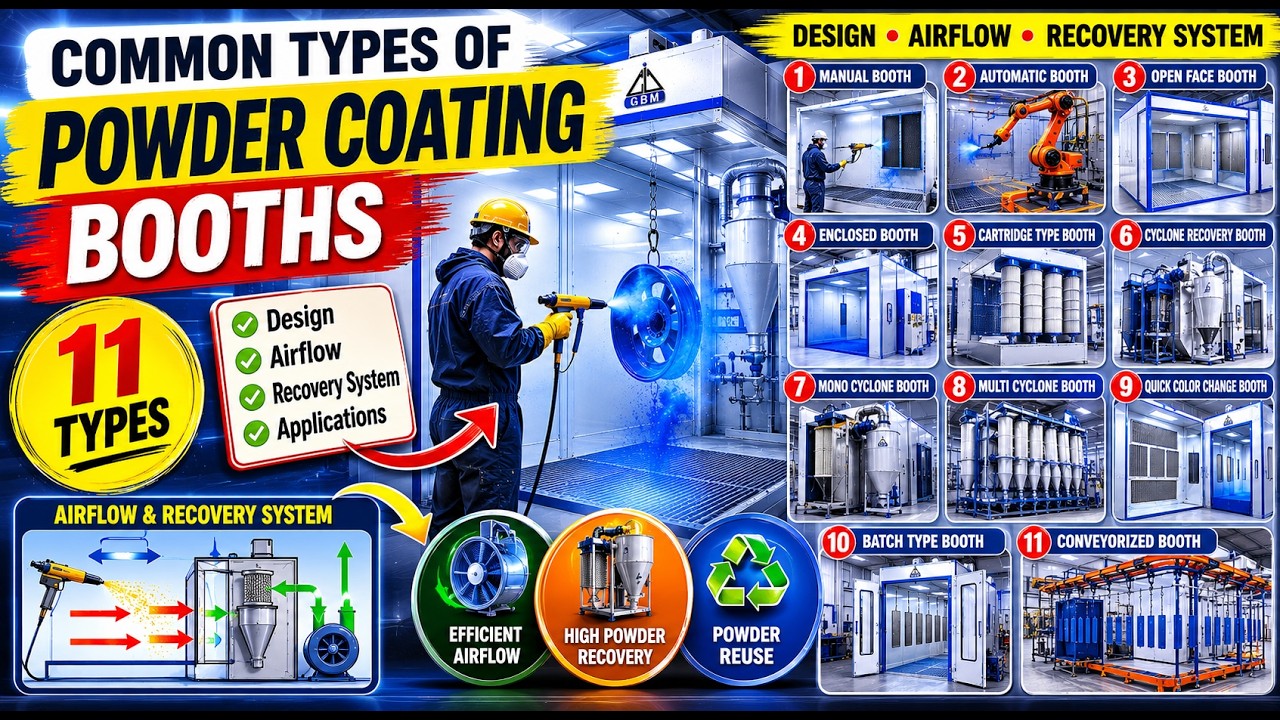
Common Types of Powder Coating Booths
Common Types of Powder Coating Booths
1. Manual Powder Coating Booth
- Powder is applied manually by the operator.
- Suitable for small and medium-scale production.
- Requires a lower initial investment.
2. Automatic Powder Coating Booth
- Powder is sprayed using robots or reciprocators.
- Ideal for high-volume production.
- Provides consistent coating quality.
3. Open Face Powder Coating Booth
- Features an open front design.
- Suitable for small parts and batch production.
- Allows easy loading and unloading of components.
4. Enclosed Powder Coating Booth
- Designed with a fully enclosed structure.
- Offers better powder containment.
- Provides a cleaner and safer working environment.
5. Cartridge Type Powder Coating Booth
- Uses cartridge filters for powder recovery.
- Recovered powder can be reclaimed and reused.
- Widely used in modern manufacturing industries.
6. Cyclone Recovery Powder Coating Booth
- Recovers overspray powder using a cyclone separator.
- Delivers high powder recovery efficiency.
- Commonly used in large-scale manufacturing facilities.
7. Mono Cyclone Powder Coating Booth
- Equipped with a single cyclone recovery system.
- Suitable for medium to high production capacities.
- Provides efficient powder recovery and reuse.
8. Multi Cyclone Powder Coating Booth
- Utilizes multiple cyclone recovery units.
- Designed for very high production environments.
- Ensures maximum powder recovery efficiency.
9. Quick Color Change Booth
- Enables rapid color changes between production runs.
- Ideal for job-work units and multi-color production applications.
- Reduces downtime and increases productivity.
10. Batch Type Powder Coating Booth
- Components are processed in batches.
- Commonly used in small and medium-sized industries.
- Suitable for customized or low-volume production.
11. Conveyorized Powder Coating Booth
- Integrated with a conveyor system.
- Designed for continuous production processes.
- Widely used in automotive, appliance, and large-scale manufacturing industries.
2. Which Booth Is Right For Me? Quiz
Not sure which powder coating booth is right for your facility? Take our interactive quiz below. Select your requirements, and the tool will instantly recommend the most suitable booth type for your production needs.
3. Compare Any Two Booths
Select any two powder coating booths from the dropdowns below to see a side-by-side comparison of their features, specifications, costs, and optimal application scenarios.
6. Powder Recovery ROI Calculator
Calculate your monthly and annual cost savings by upgrading from a standard filter-to-waste booth to an advanced cyclone powder recovery booth. Enter your monthly production volume (powder consumed), current powder wastage percentage, and powder cost below.
10. "Find My Powder Coating Plant Setup" Configurator
Planning a complete powder coating factory? Use this advanced setup configurator to design your entire plant layout. Select your target industry, available workshop space, budget, and daily production capacity below to generate a tailored equipment blueprint, estimated cost, and floor layout scheme.
What Is a Manual Powder Coating Booth?

A Manual Powder Coating Booth is a specially designed cabin or enclosure inside which a worker sprays powder onto metal parts using a powder coating gun. The booth is equipped with a suction system and filters that collect excess powder (overspray) floating in the air.
What Does It Look Like?
Visualize the system setup:
- A rectangular cabin or chamber
- The front side is open or partially open
- The side and back walls are enclosed
- The operator stands inside or outside the booth and performs the spraying
- Exhaust fans and cartridge filters are installed at the back of the booth
- Components are suspended on hooks or placed on stands
- White LED lighting is provided so the coating can be seen clearly
- A powder recovery system is located at the bottom or rear side
Working Process
Step 1: Component Loading
The metal component is placed inside the booth on a rack, stand, or hook.
Step 2: Powder Spraying
The operator sprays powder using an electrostatic powder coating gun.
Step 3: Powder Attraction
Due to the electrostatic charge, the powder adheres to the metal surface.
Step 4: Overspray Collection
The powder that does not stick to the component is collected by the booth's filter system.
Step 5: Component Transfer
The coated component is transferred to a curing oven.
Main Components of a Manual Powder Coating Booth
Booth Structure
- GI Sheet
- Powder-Coated Steel
- Stainless Steel (Optional)
Cartridge Filters
- Collect overspray powder
- Release clean air outside
Exhaust Fan / Blower
- Maintains airflow
- Pulls powder particles toward the filters
Recovery Hopper
- Collects excess powder
- Stores it for reuse
LED Lights
- Improve visibility
Powder Coating Gun
- Used manually by the operator
Where Is It Used?
Manual Powder Coating Booths are commonly used in:
Advantages
- Low investment cost
- Easy operation
- Less maintenance
- Small space requirement
- Can coat different size components
- Best for small production units
- Easy color change
Disadvantages
- Coating quality depends on operator skill
- Production is slower compared to automatic lines
- Higher labor requirement
- Not suitable for large-scale production
Manual Booth vs Automatic Booth
| Feature | Manual Booth | Automatic Booth |
|---|---|---|
| Investment | Low | High |
| Production Capacity | Medium | Very High |
| Operator Required | Yes | Minimal |
| Color Change | Easy | Complex |
| Maintenance | Low | Higher |
| Suitable For | Job Work & SMEs | Large Factories |
Common Sizes Offered by Manufacturers
What Is an Automatic Powder Coating Booth?

An Automatic Powder Coating Booth is an advanced powder coating system where powder spraying is not performed manually by an operator. Instead, the coating process is carried out by automatic reciprocators, robots, or automatic powder coating guns.
In this system, components enter the booth through a conveyor, automatic guns apply the powder coating, and the components then move toward the curing oven.
What Does It Look Like?
Visualize the system setup:
- A large enclosed powder coating booth
- A conveyor line passing through the center of the booth
- Multiple automatic spray guns installed on both sides
- Guns mounted on reciprocators (up-and-down moving mechanisms)
- Components suspended on conveyor hooks
- Cartridge filters or a cyclone recovery system located at the rear of the booth
- An automatic control panel and PLC system
- An integrated powder recovery and reuse system
Working Process
1. Component Loading
Metal parts are hung on the conveyor system.
2. Automatic Spraying
Reciprocators and automatic guns spray powder in a programmed pattern.
3. Powder Recovery
Excess powder is collected in a cyclone or cartridge recovery system.
4. Curing Process
The coated parts automatically move into the curing oven through the conveyor system.
5. Finished Product
After exiting the oven, the finished coated components are ready for use.
Main Components of an Automatic Powder Coating Booth
Booth Structure
- Powder-coated steel construction
- Fully enclosed design
Automatic Spray Guns
- Multiple electrostatic powder guns
- Uniform coating application
Reciprocator System
- Moves the guns up and down
- Ensures complete coating coverage
Conveyor System
- Continuously transports components through the process
Cartridge Filter / Cyclone Recovery System
- Recovers overspray powder
Exhaust Blower
- Maintains proper airflow inside the booth
PLC Control Panel
- Controls complete system automation
Powder Feed Center
- Automatic powder supply
- Color change management
Where Is It Used?
Automatic Powder Coating Booths are commonly used in:
Advantages
- Very high production capacity
- Uniform coating quality
- Less powder wastage
- Lower labor requirement
- Consistent finish quality
- Faster production speed
Disadvantages
- High initial investment
- More maintenance requirements
- Skilled setup and programming required
- Expensive for small job-work units
Manual vs Automatic Booth
| Feature | Manual Booth | Automatic Booth |
|---|---|---|
| Spray Method | Operator | Automatic Guns |
| Production Capacity | Medium | Very High |
| Labor Requirement | High | Low |
| Consistency | Operator Dependent | Highly Consistent |
| Investment | Low | High |
| Best For | Small & Medium Units | Large Manufacturing Plants |
What Is an Open Face Powder Coating Booth?

An Open Face Powder Coating Booth is the most common and simplest type of powder coating booth design. In this configuration, the front side of the booth is completely open, while the side and rear walls are enclosed.
The operator sprays powder onto the component from the open front area, while the filters and exhaust system installed at the rear of the booth collect the overspray powder.
What Does It Look Like?
Visualize the system setup:
- Front side completely open
- Side and rear walls enclosed
- Cartridge filters installed at the rear side
- Exhaust blower mounted at the back
- LED lights installed inside the booth
- Components placed on hooks, stands, or trolleys
- Operator performs spraying from the front side
Where Is It Used?
Open Face Powder Coating Booths are commonly used in:
Advantages
- Low cost
- Easy operation
- Easy loading and unloading
- Requires less space
- Simple maintenance
Disadvantages
- Lower powder containment compared to fully enclosed booths
- Not ideal for very high-volume production
What Is an Enclosed Powder Coating Booth?

An Enclosed Powder Coating Booth is a fully covered powder coating booth in which the front, side, and rear sections are mostly enclosed. Its primary purpose is to contain powder within the booth and maintain a clean working environment.
Compared to an Open Face Powder Coating Booth, it significantly reduces powder leakage and contamination.
What Does It Look Like?
Visualize the system setup:
- Fully enclosed cabin structure
- Entry and exit openings or conveyor slots
- Side and rear walls completely covered
- Enclosed roof structure
- High-efficiency cartridge filters or cyclone recovery system
- Internal LED lighting
- Powder recovery hopper
- Exhaust blower and airflow management system
- Components are coated inside the enclosed booth
Where Is It Used?
Enclosed Powder Coating Booths are commonly used in:
Advantages
- Better powder containment
- Cleaner working environment
- Higher powder recovery efficiency
- Reduced contamination
- Improved coating quality
- Suitable for automated powder coating systems
Disadvantages
- Higher cost compared to open face booths
- Requires more installation space
- Installation is comparatively more complex
Open Face Booth vs Enclosed Booth
| Feature | Open Face Booth | Enclosed Booth |
|---|---|---|
| Front Side | Open | Mostly Enclosed |
| Powder Containment | Good | Excellent |
| Recovery Efficiency | Good | Better |
| Initial Cost | Lower | Higher |
| Cleanliness | Good | Excellent |
What Is a Cartridge Type Powder Coating Booth?

A Cartridge Type Powder Coating Booth is a powder coating booth that uses cartridge filters to collect overspray powder. Today, it is one of the most popular and widely used types of powder coating booths.
When an operator or automatic gun sprays powder, the excess powder that does not adhere to the component is drawn toward the cartridge filters by the airflow system. The filters capture the powder while allowing clean air to pass through and exit the booth.
What Does It Look Like?
Visualize the system setup:
- Open face or enclosed booth structure
- Multiple cylindrical cartridge filters mounted at the rear side
- Exhaust blower system
- Powder recovery hopper
- Pulse jet cleaning system
- Bright LED lighting
- Manual or automatic powder coating setup
Working Process
1. Powder Spraying
Powder is sprayed onto the component.
2. Overspray Movement
Excess powder moves toward the filters along with the airflow.
3. Powder Capture
Cartridge filters capture the powder particles.
4. Air Discharge
Clean air is discharged through the blower system.
5. Filter Cleaning
The pulse jet system cleans the filters automatically.
6. Powder Collection
The collected powder falls into the recovery hopper and can be reused.
Main Components
Booth Structure
- GI Sheet
- Powder-Coated Steel
Cartridge Filters
- Collect overspray powder
- Allow clean air to pass through
Pulse Jet Cleaning System
- Cleans the filters using compressed air
Exhaust Blower
- Maintains proper airflow
Recovery Hopper
- Collects recovered powder
LED Lights
- Improve visibility
Powder Coating Gun
- Manual or Automatic
Where Is It Used?
Cartridge Type Powder Coating Booths are commonly used in:
Advantages
- High powder recovery efficiency
- Cleaner working environment
- Low powder wastage
- Easy maintenance
- Better filter performance
- Cost-effective solution
Disadvantages
- Filters need to be replaced periodically
- Recovery efficiency may be slightly lower compared to a cyclone recovery system
What Is a Cyclone Recovery Powder Coating Booth?

A Cyclone Recovery Powder Coating Booth is an advanced powder coating booth that uses a Cyclone Separator System to recover overspray powder.
In a cartridge booth, overspray powder is collected by filters, whereas in a Cyclone Recovery Booth, air and powder are separated using a cyclone separator. This significantly increases powder recovery efficiency, and the recovered powder can be directly reused in the coating process.
What Does It Look Like?
Visualize the system setup:
- Large powder coating booth (open face or enclosed)
- A large conical cyclone separator mounted on the side or rear
- Powder recovery hopper
- After-filter unit (cartridge filters)
- Exhaust blower
- Automatic powder feed center
- Conveyorized or manual coating setup
Working Process
Step 1: Spraying
Powder is sprayed onto the component.
Step 2: Suction
The powder that does not adhere to the component (overspray) is carried by the airflow into the cyclone separator.
Step 3: Separation
The cyclone creates a high-speed circular airflow.
Step 4: Collection
The heavier powder particles fall into the hopper below.
Step 5: Filtration
Clean air passes through the after-filters.
Step 6: Direct Reuse
The recovered powder is reused in the coating process.
Main Components
Powder Coating Booth
- Open face or enclosed structure
Cyclone Separator
- Cone-shaped recovery chamber
- Separates powder from air
Recovery Hopper
- Collects recovered powder
After Filter Unit
- Captures fine powder particles
Exhaust Blower
- Maintains proper airflow
Powder Feed Center
- Supplies recovered powder for reuse
PLC Control System
- Controls automated operation
Where Is It Used?
Cyclone Recovery Powder Coating Booths are commonly used in:
Advantages
- Very high powder recovery efficiency
- Very low powder wastage
- Fast color change capability
- Ideal for large-scale production
- Better operational efficiency
- Recovered powder can be directly reused
Disadvantages
- Higher initial investment
- Requires more installation space
- Maintenance is comparatively more complex
- Expensive for small job-work units
Cartridge Booth vs Cyclone Booth
| Feature | Cartridge Booth | Cyclone Booth |
|---|---|---|
| Recovery Method | Filters | Cyclone Separator |
| Recovery Efficiency | Good | Very High |
| Powder Reuse | Limited | Excellent |
| Initial Cost | Lower | Higher |
| Production Volume | Medium | High |
What Is a Mono Cyclone Powder Coating Booth?

A Mono Cyclone Powder Coating Booth is a powder coating booth that uses only one (single) cyclone separator for powder recovery. The term "Mono" itself means single.
This booth is a type of Cyclone Recovery Powder Coating Booth, where overspray powder is recovered by a single cyclone unit and collected for reuse.
What Does It Look Like?
Visualize the system setup:
- Powder coating booth (open face or enclosed)
- One large cone-shaped cyclone separator
- Recovery hopper
- After-filter unit
- Exhaust blower
- Powder feed center
- Manual or automatic coating setup
Visualize It
- Components are being coated inside the booth
- Overspray powder is moving through ducting into the cyclone
- The cyclone separates powder from air
- Powder is collected in the hopper
- Clean air exits through the filters
Working Process
Step 1: Spraying
Powder is sprayed onto the components.
Step 2: Airflow Movement
Excess powder moves into the cyclone separator along with the airflow.
Step 3: Rotational Airflow
The cyclone creates a rotational airflow.
Step 4: Collection
Powder particles are collected in the hopper below.
Step 5: Powder Reuse
The recovered powder is reused in the coating process.
Step 6: Fine Particle Capture
The remaining fine particles are captured by the after-filters.
Main Components
Powder Coating Booth
- Open face or enclosed design
Mono Cyclone Separator
- Single cone-shaped recovery unit
Recovery Hopper
- Collects recovered powder
After Filters
- Capture fine powder particles
Exhaust Blower
- Maintains airflow
Powder Feed Center
- Supplies recovered powder for reuse
Control Panel
- Manages system operation
Where Is It Used?
Mono Cyclone Powder Coating Booths are commonly used in:
Advantages
- High powder recovery efficiency
- Less powder wastage
- Lower operating cost
- Faster color changes
- Better performance than standard cartridge-only recovery systems
- Easy powder reuse
Disadvantages
- Higher cost than cartridge booths
- Requires more installation space
- Recovery efficiency is lower than multi-cyclone systems
Mono Cyclone vs Multi Cyclone
| Feature | Mono Cyclone | Multi Cyclone |
|---|---|---|
| Cyclone Quantity | 1 | Multiple |
| Recovery Capacity | High | Very High |
| Production Scale | Medium–High | Very High |
| Cost | Lower | Higher |
| Maintenance | Easier | More Complex |
What Is a Multi Cyclone Powder Coating Booth?

A Multi Cyclone Powder Coating Booth is an advanced powder coating recovery system that uses multiple cyclone separators instead of just one. This system is designed for very high production volumes and large-scale manufacturing plants.
When the volume of powder coating is very high, multiple cyclones make the powder recovery process more efficient.
Mono vs Multi Cyclone Recovery
- Mono Cyclone Booth: 1 Cyclone Separator
- Multi Cyclone Booth: 2 or More Cyclone Separators
What Does It Look Like?
Visualize the system setup:
- Large automatic powder coating booth
- Conveyorized coating line
- Multiple cone-shaped cyclone separators
- Recovery hoppers
- After-filter units
- Exhaust blower system
- Powder feed center
- PLC control panel
Visualize It
- Components are moving along a conveyor system
- Automatic guns are spraying powder
- Overspray powder is distributed through ducting into multiple cyclones
- Each cyclone recovers powder separately
- Powder is collected in recovery hoppers
- Clean air passes through the filtration system
Working Process
Step 1: Coating
Components are coated inside the booth.
Step 2: Suction
Overspray powder enters the cyclone system along with the airflow.
Step 3: Distribution
The powder is distributed among multiple cyclone separators.
Step 4: Separation
The cyclones separate powder from air.
Step 5: Collection
Recovered powder is collected in recovery hoppers.
Step 6: Filtration & Exhaust
Clean air exits through the after-filter system.
Main Components
Powder Coating Booth
- Large enclosed booth
Multiple Cyclone Separators
- Two or more cyclone units
Recovery Hoppers
- Collect recovered powder
After Filter System
- Removes fine powder particles
Exhaust Blower
- Maintains airflow
Powder Feed Center
- Reuses recovered powder in the coating process
PLC Automation System
- Controls the complete plant operation
Where Is It Used?
Multi Cyclone Powder Coating Booths are commonly used in:
Advantages
- Very high powder recovery efficiency
- Minimum powder wastage
- Suitable for large-scale production
- Better airflow distribution
- High operational efficiency
- Consistent coating quality
Disadvantages
- Very high initial investment
- Requires a large installation area
- Complex maintenance requirements
- Not practical for small industries
Mono Cyclone vs Multi Cyclone
| Feature | Mono Cyclone | Multi Cyclone |
|---|---|---|
| Cyclones | 1 | Multiple |
| Recovery Capacity | High | Very High |
| Production Volume | Medium–High | Very High |
| Cost | Lower | Higher |
| Space Requirement | Less | More |
| Recovery Efficiency | High | Maximum |
What Is a Quick Color Change Booth?

A Quick Color Change Booth is a specially designed powder coating booth that allows operators to switch from one powder color to another in a very short amount of time.
In conventional powder coating booths, changing colors can take considerable time because the booth, hoses, powder center, and filters must be thoroughly cleaned. In a Quick Color Change Booth, the design and recovery system are engineered to make the cleaning process much faster and more efficient.
What Does It Look Like?
Visualize the system setup:
- Smooth enclosed booth structure
- Rounded or sloped internal walls
- No flat corners to prevent powder accumulation
- Automatic cleaning system
- Cyclone recovery system
- Quick color change powder center
- Automatic spray guns and reciprocators
- Conveyorized production line
Visualize It
- A white or light-colored enclosed booth
- Automatic guns spraying powder onto components
- Components moving through the booth on a conveyor system
- Compressed air cleaning taking place inside the booth
- A rapid transition from one powder color to another
Working Process
Step 1: First Color Spraying
The first powder color is sprayed onto the components.
Step 2: Batch Completion
The production batch is completed.
Step 3: Cleaning Cycle Start
The automatic cleaning cycle begins.
Step 4: System Cleaning
The booth walls and recovery system are cleaned.
Step 5: New Color Loading
A new powder color is loaded into the system.
Step 6: Resuming Production
Production resumes with the new coating color.
Main Components
Smooth Enclosed Booth
- Minimizes powder accumulation
Cyclone Recovery System
- Enables fast powder removal
Quick Color Change Powder Center
- Allows rapid cleaning of the powder feed system
Automatic Spray Guns
- Provide consistent coating quality
Reciprocators
- Move the spray guns automatically
Conveyor System
- Supports continuous production
PLC Control Panel
- Controls automatic cleaning and system operation
Where Is It Used?
Quick Color Change Booths are commonly used in:
Advantages
- Fast color change capability
- Reduced production downtime
- Higher productivity
- Less powder contamination
- Better quality control
- Ideal for multiple color production
Disadvantages
- Higher investment cost
- More complex automation system
- Maintenance requirements may be higher
What Is a Batch Type Powder Coating Booth?

A Batch Type Powder Coating Booth is a powder coating setup in which components are loaded in batches (groups), coated with powder, and then the entire batch is transferred to a curing oven.
Unlike conveyorized systems, there is no continuous production flow. The process is carried out batch by batch, which is why it is also known as a Batch Type Powder Coating System.
What Does It Look Like?
Visualize the system setup:
- Manual or semi-automatic powder coating booth
- Components mounted on racks, stands, or trolleys
- Open-face or enclosed booth design
- Cartridge filter or cyclone recovery system
- Nearby batch type curing oven
- Components are loaded and unloaded manually
Visualize It
- A trolley holding 20–50 metal components
- The trolley is moved into the powder coating booth
- An operator performs the powder coating process
- The entire trolley is transferred to the curing oven
- After curing, the finished batch is removed and the next batch begins
Working Process
Step 1: Component Loading
Components are loaded onto a trolley or rack.
Step 2: Powder Coating
The batch is powder coated inside the booth.
Step 3: Transfer to Oven
The coated components are transferred to the curing oven.
Step 4: Curing
The entire batch is cured.
Step 5: Completion & Restart
The finished batch is removed, and the next batch is started.
Main Components
Powder Coating Booth
- Open-face or enclosed design
Powder Coating Gun
- Manual or automatic
Filter System
- Cartridge or cyclone recovery system
Trolley / Rack System
- Holds the components during coating and curing
Batch Type Curing Oven
- Cures the powder coating
Exhaust Blower
- Maintains proper airflow
Control Panel
- Controls equipment operation
Where Is It Used?
Batch Type Powder Coating Booths are commonly used in:
Advantages
- Low investment cost
- Flexible production
- Can handle components of different sizes
- Easy operation
- Ideal for small businesses
- Requires less space
Disadvantages
- No continuous production
- Higher labor requirement
- Lower production speed compared to conveyorized systems
- Not suitable for large-scale manufacturing
Batch Type vs Conveyorized System
| Feature | Batch Type | Conveyorized |
|---|---|---|
| Production Method | Batch-wise | Continuous |
| Investment | Lower | Higher |
| Labor Requirement | More | Less |
| Production Speed | Medium | High |
| Flexibility | High | Moderate |
| Best For | SMEs & Job Work | Large Factories |
What Is a Conveyorized Powder Coating Booth?

A Conveyorized Powder Coating Booth is a powder coating system in which components are automatically moved through a conveyor chain system instead of being manually handled.
In this system, components start from the loading station and continuously move through the powder coating booth, curing oven, and unloading area via the conveyor system.
It is considered one of the most common and efficient systems for large-scale production.
What Does It Look Like?
Visualize the system setup:
- Long overhead conveyor chain
- Powder coating booth
- Automatic or manual spray guns
- Cyclone or cartridge recovery system
- Curing oven
- Loading station
- Unloading station
- PLC control system
Visualize It
- Metal components are suspended on hooks
- They continuously move along an overhead conveyor
- Components enter the powder coating booth
- Automatic guns apply the powder coating
- The components then enter the curing oven
- After curing, the finished products reach the unloading area
Working Process
Step 1: Loading
Components are hung on conveyor hooks.
Step 2: Powder Coating
The components enter the powder coating booth, where the coating process takes place.
Step 3: Powder Recovery
The powder recovery system collects overspray powder.
Step 4: Curing
The conveyor directly transports the coated components into the curing oven.
Step 5: Unloading
Finished coated parts are removed at the unloading station.
Main Components
Overhead Conveyor System
- Moves components through the entire process
Powder Coating Booth
- Manual or automatic configuration
Powder Recovery System
- Cartridge or cyclone type
Automatic Spray Guns
- Provide uniform powder application
Reciprocators
- Move the spray guns automatically
Curing Oven
- Cures the powder coating
PLC Control Panel
- Controls the entire production line
Loading & Unloading Stations
- Used for material handling
Where Is It Used?
Conveyorized Powder Coating Booths are commonly used in:
Advantages
- Continuous production
- High productivity
- Reduced labor requirement
- Consistent coating quality
- Faster processing
- Suitable for mass production
Disadvantages
- High initial investment
- Requires more installation space
- Higher maintenance costs
- Not practical for small-scale production
Batch Type vs Conveyorized System
| Feature | Batch Type | Conveyorized |
|---|---|---|
| Production Method | Batch-wise | Continuous |
| Labor Requirement | More | Less |
| Output Capacity | Medium | Very High |
| Investment | Lower | Higher |
| Automation Level | Low | High |
Conclusion
Choosing the right powder coating booth depends on your production volume, budget, automation requirements, and desired coating quality. From simple Manual and Open Face Booths to advanced Cyclone Recovery and Conveyorized Powder Coating Booths, each type offers unique advantages for different industrial applications.
Understanding the features, working process, and benefits of each booth type can help manufacturers select the most efficient solution for their powder coating operations, improve productivity, reduce powder wastage, and achieve consistent coating quality.
Watch: 11 Types of Powder Coating Booths
Watch this practical video walkthrough to see the 11 different types of powder coating booths in action, demonstrating their design, airflow containment, and recovery processes.
Frequently Asked Questions (FAQ)
Find answers to the most common questions about industrial powder coating booths, recovery systems, and selecting the right equipment for your shop.
Powder coating booths use an exhaust fan to draw air into the booth, capturing overspray powder before it escapes into the workshop. The air-powder mixture passes through filters (like cartridge filters) or a cyclone separator, which captures the powder particles, allowing clean air to be safely recirculated into the facility.
The primary difference lies in the recovery method:
- Cartridge Booth: Uses cartridge filters to capture powder. Changing colors requires swapping or cleaning the cartridges, which is slower but highly efficient for single-color operations.
- Cyclone Booth: Uses a centrifugal cyclone separator to spin powder out of the air stream, allowing up to 95–99% of the powder to be reclaimed and reused instantly. It is ideal for shops that change colors frequently.
Yes, but it depends on the recovery system. Systems with cyclone separators or specialized cartridge recovery hoppers collect overspray powder in a clean hopper, allowing it to be sieved and fed back into the gun. In standard filter-to-waste booths, the powder collected in the waste drawer is usually a mix of multiple colors and cannot be reused.
Color change times vary significantly based on design:
- Standard Cartridge Booth: 45 to 90 minutes (requires vacuuming the booth and changing filters).
- Mono/Multi-Cyclone Booth: 15 to 30 minutes (requires cleaning the booth floor and cyclone hopper).
- Quick Color Change Booth: Under 10 to 15 minutes (features self-cleaning non-stick walls, automated purging, and an integrated powder feed center).
For small job shops or startups, a Batch Type or Open Face Cartridge Booth is the most practical choice. They have a lower upfront cost, require less floor space, and are highly flexible for coating custom parts, wheel rims, and small metal fabrications in batches.
Choosing reliable Powder Coating Booth Manufacturers is essential for achieving a smooth finish, effective overspray control, and consistent coating quality. MV International offers industrial coating solutions designed to support different production requirements and improve finishing efficiency.
ReplyDelete